
Cold Drawn Steel Profile Raw Material for Linear Guide Manufacturing
Short Answer for Guide-Rail Raw-Material Buyers
Junxiong Metal supplies drawing-based cold drawn steel profile raw material and blanks for downstream manufacturers to machine, heat treat and grind into linear-guide rails. Buyers should send the intended rail drawing, exact grade and standard, section dimensions, datums, straightness and twist limits, raceway allowance, downstream hardening route, grinding stock, inspection plan, annual volume and destination.
Controlled buyer-search routes below cover Germany/DIN, wider Europe/EN-ISO, Japan/JIS, Korea/KS, China/GB or customer drawings and USA/SAE terminology. They are separate procurement routes, not automatic grade equivalence.
For an approved drawing and feasible grade, the quoted raw-material scope can optionally include drilling and high-frequency induction hardening before shipment. A target surface hardness of HRC 58 or higher is an order-specific value-added processing capability; the supplied item remains a semi-finished steel profile blank requiring downstream validation.
This is strictly an upstream cold-drawn raw-material page. Junxiong is not presenting or selling a finished linear guide, rail-and-block assembly, carriage kit or branded replacement rail.
Send the linear-rail profile drawing or send the specification by WhatsApp.
Cold-Drawn Raw Profile for Downstream Guide-Rail Manufacturing
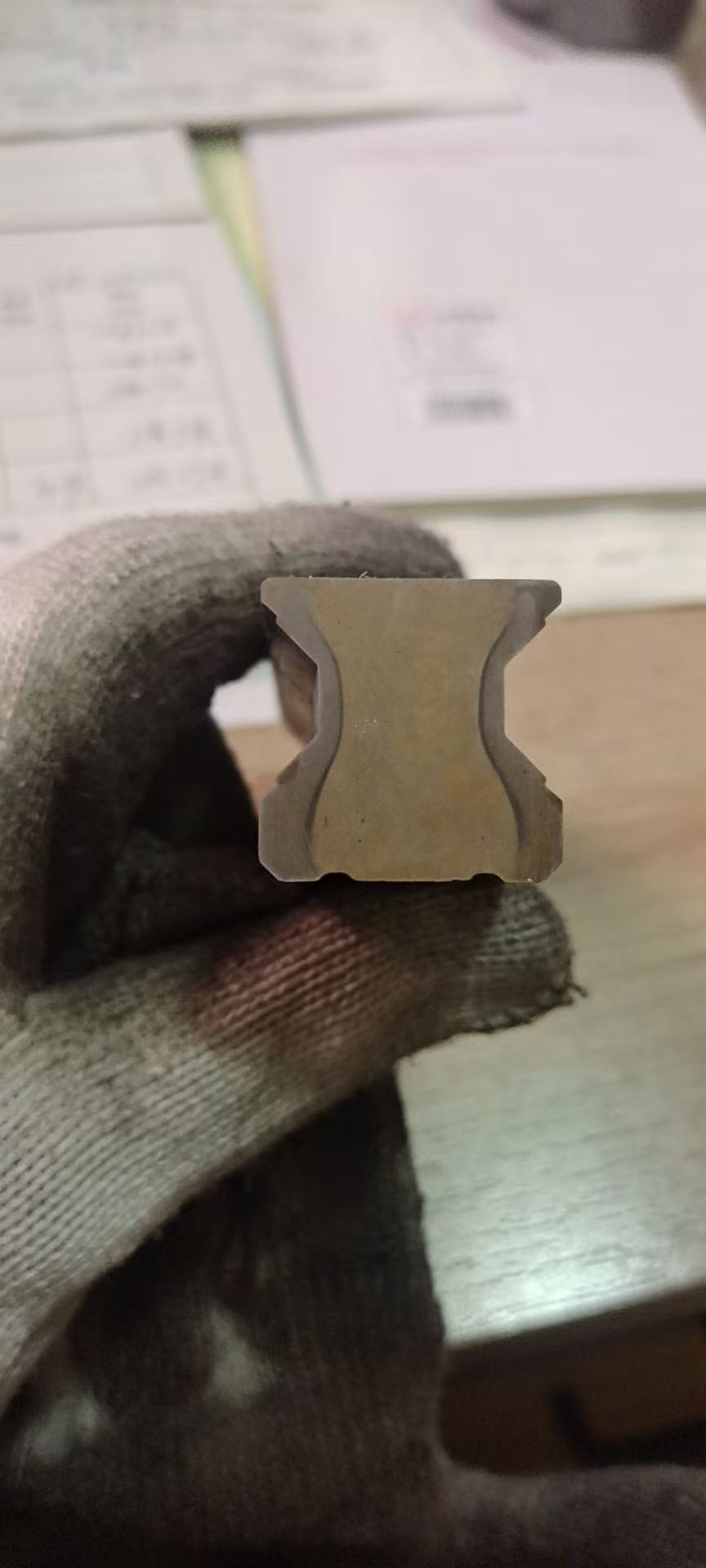
Image boundary: the owner-supplied photograph shows a cold-drawn steel profile raw-material form. It does not show a complete or installation-ready linear guide and cannot prove any grade, standard, hardness or heat identity by appearance.
Optional Processing on Cold-Drawn Raw Profile Blanks
Junxiong can review a value-added raw-profile scope that includes drawing-defined holes and high-frequency induction hardening before shipment. Even with these optional operations, the supply remains a semi-finished steel profile blank rather than a finished guide rail. The process sequence must follow the drawing and validation plan; drilling may occur before or after hardening only when tool access, distortion, edge condition and hardness requirements permit.
| Purchase field | Required acceptance definition |
|---|---|
| Surface hardness | Target HRC 58 or higher only where the order specifies it; state the measuring locations, method, minimum readings and permitted variation. |
| Hardened zone | Mark the raceway or other hardened surfaces and state the effective hardened-layer depth, transition-zone limits and core-property requirement. |
| Hole pattern | Define hole diameter, pitch, datum, positional tolerance, thread/countersink details, burr limit and whether holes are made before or after hardening. |
| Distortion control | State straightness, twist and camber after drilling and hardening, plus any re-straightening, grinding stock and final inspection stage. |
| Verification | Define hardness records, case-depth check, crack inspection, profile report, hole report and traceability required with the shipment. |
Hardness boundary: HRC 58+ is a quoteable Junxiong processing target, not a universal guarantee for every rail section or duty cycle. THK’s public LM Roller guidance also recommends HRC 58 or higher for that specific raceway application, while the buyer drawing, hardened depth and life/load design remain controlling.
Germany, Europe, Japan and Korea Linear Guide Rail Steel Routes
Buyers often search by a regional grade name. These rows are controlled enquiry routes for upstream cold-drawn profile blanks. They do not claim that every listed material can be cold drawn into every section, that Junxiong holds every grade in stock, or that designations on different rows are interchangeable.
| Market or search route | Buyer designation | Relevant component context | Procurement boundary |
|---|---|---|---|
| Germany / DIN application reference | 90MnCrV8 / 1.2842 | Finished precision rail guide material reference. | Schaeffler identifies this route for one finished precision-rail family. That reference does not prove cold-drawing feasibility, Junxiong stock or acceptance for the buyer’s profile. |
| Germany / DIN EN ISO bearing route | 100Cr6 / 1.3505 | Rolling elements or a drawing-specified rolling-contact component. | Use the exact DIN EN ISO 683-17 edition, product form, cleanliness, heat treatment and MTC criteria. It is not the default material for every rail blank. |
| Germany / DIN corrosion-resistant reference | X90CrMoV18 / 1.4112; X46Cr13 / 1.4034; X65Cr13 / 1.4037 | Finished corrosion-resistant rail references. | These are manufacturer application examples, not a universal stainless substitution set or an unconditional cold-drawn profile offer. |
| Europe / EN-ISO buyer route | C55E or buyer-specified C55 family | Selected induction-hardened rail or track blank. | The exact EN/ISO grade, edition, bar-product route, condition and downstream hardening plan control. Do not relabel it as JIS S55C or Korean SM55C. |
| Europe / EN-ISO case-hardening route | 20MnCr5 / 1.7147 | Selected drawing-specific case-hardened rail or component blank. | Use only when the drawing specifies this route. It is not a universal linear-guide grade and is not automatically SCM415, SCM420 or 20CrMo. |
| Japan / JIS G 4051 | S55C | Selected medium-carbon induction-hardened track-rail design. | Documented application route, not a universal rail grade. Confirm the exact JIS edition, raw-product route, condition and hardening plan. |
| Japan / JIS G 4053 | SCM415 | Selected case-hardened track-rail design. | Quote only against the buyer’s exact standard, section and case/core requirements. Do not treat it as an automatic 20MnCr5, 20CrMo or SCM420 substitute. |
| Japan / JIS G 4805 | SUJ2 | Drawing-specified rolling-contact component. | Bearing-steel route only; it is not proof that the long rail profile should use SUJ2. |
| Korea / KS D 3752 | SM55C | Buyer-specified machine-structural carbon-steel rail or track blank. | Separate Korean procurement route. Confirm the exact KS edition and drawing; do not silently rename it S55C, C55E or SAE 1055. |
| Korea / KS D 3867 | SCM415 or SCM420 | Buyer-specified alloy-steel rail or related component blank. | The Korean standard covers alloy steel for machine structures and identifies downstream cold drawing and heat-treatment routes; component drawing, condition and MTC still control. |
| Korean producer application terms | S58C, SCM420H, 60Cr3 or CF53 | Linear-motion guide bearing material search terms disclosed by SeAH Besteel. | These terms are not one KS equivalence set and do not prove Junxiong stock, cold-drawing feasibility or suitability for the buyer’s rail profile. |
| Korea / KS D 3525 | STB2 | Drawing-specified rolling-bearing component. | High-carbon chromium bearing-steel route only. It is not the universal material for the rail, slider and module base. |
| China / GB or customer drawing | GCr15 or buyer-specified carbon/alloy steel | Rolling-contact or drawing-specific raw-profile route. | Use the exact GB/customer specification and component identity. GCr15 is not automatically 100Cr6, 52100, SUJ2 or STB2. |
| USA / SAE buyer route | SAE 1055 or SAE 52100 | Separate medium-carbon or bearing-steel component route. | The applicable SAE/ASTM product standard, section, condition, heat treatment and MTC control acceptance. |
Regional-name boundary: Germany commonly purchases through DIN adoptions of European or ISO standards, so German and European wording can point to the same standard family. Search wording never replaces the exact ordered standard, edition, chemistry, product form, condition, drawing and heat-specific MTC.
Technical Facts That Control Rail-Blank Feasibility
| Decision | Buyer information required |
|---|---|
| Drawing | Full cross-section, datums, critical surfaces, radii, grooves, raceway position and machining stock. |
| Material | Exact grade, governing standard and edition, delivery condition, chemistry, hardenability and MTC scope. |
| Dimensions | Section tolerance, straightness per length, twist, camber, length, cut-end and burr limits. |
| Process route | Cold drawing or other reduction route, intermediate annealing, machining, hardening and finish grinding sequence. |
| Raceway allowance | Material remaining for raceway machining, heat-treatment distortion and final grinding. |
| Heat treatment | Induction or case-hardening route, target surface hardness, effective case depth and core-property criteria. |
| Inspection | Profile measurement method, straightness/twist method, surface limits, decarburization, hardness and first-article plan. |
| Commercial | Trial length, annual demand by section, packing, destination and schedule. |
Profile Blank vs Finished Linear Guide
A finished linear guide includes a hardened and ground rail, one or more moving blocks, rolling elements, recirculation details, seals, lubrication and assembly-level accuracy. A cold drawn profile blank is an upstream input that still needs drawing-specific machining, heat treatment, grinding and validation.
Google Keyword Planner reports high search volume for linear guide rail, but that volume is dominated by finished-product intent. It is not evidence that the same buyers want steel profile blanks, so the broad term is excluded from Junxiong’s upstream Ads plan.
Buyer Checklist
- Dimensioned cross-section and rail length drawing.
- Exact grade, standard, edition and delivery condition.
- Datums, critical tolerances, straightness, twist and camber.
- Raceway machining, hardening and grinding allowances.
- Surface-hardness, case-depth and core-property targets.
- First-article, profile, surface and traceability requirements.
- Trial quantity, annual volume, destination and schedule.
FAQ
Does Junxiong sell finished linear guides?
No. This page covers upstream cold-drawn steel profile raw material for downstream rail manufacturers. The drawing review defines whether Junxiong supplies the as-drawn blank or includes an agreed value-added operation; neither scope is an assembled or installation-ready linear guide.
Is every linear-guide rail made from S55C?
No. S55C is one documented route. Rail makers also use other carbon, alloy, stainless or buyer-specific materials depending on hardening, accuracy, corrosion and service requirements.
Are GCr15, 100Cr6, 52100, SUJ2 and STB2 automatically interchangeable?
No. They form a useful cross-market bearing-steel comparison family, but the governing standards, chemistry, condition, product form and buyer drawing must be checked before substitution.
Are German, European, Japanese and Korean guide-rail grade names interchangeable?
No. DIN/EN/ISO, JIS and KS designations are separate purchase routes. Even similar chemistry names require the exact standard and edition, product form, supplied condition, hardenability or hardness criteria, drawing approval and matching MTC before substitution.
Can a photograph prove the rail grade?
No. A photograph can document shape and process context only. Grade and batch identity require the approved order, heat traceability and matching MTC.
Can Junxiong deliver the rail blank drilled and induction hardened?
Yes, as optional value-added processing on the cold-drawn raw profile when the drawing, grade, section and validation plan are feasible. The order must define hole geometry and datum, hardened location, target surface hardness of HRC 58 or higher, effective hardened depth, post-treatment straightness and the required inspection records. The delivered item remains a semi-finished blank, not a finished guide.
What makes an enquiry quotable?
A dimensioned drawing, exact grade/standard, tolerances, downstream process, inspection scope, annual volume and destination make the enquiry quotable.
Primary Technical References
- Track-rail manufacturing example using S55C or SCM415
- NSK linear-motion material-family reference
- IKO linear-way material-family reference
- THK stainless linear-guide route
- THK raceway hardness and induction-hardening guidance
- Schaeffler precision rail guide material references
- DIN EN ISO 683-17 bearing-steel standard record
- Official JISC standards search for JIS G 4051, JIS G 4053 and JIS G 4805
- Official KS D 3752 machine-structural carbon-steel record
- Official KS D 3867 machine-structural alloy-steel record
- Official KS D 3525 high-carbon chromium bearing-steel record
- SeAH Besteel linear-motion guide bearing material application terms
- Ovako 20MnCr5 producer data
- Ovako 100Cr6 producer data
Reference boundary: manufacturer pages describe finished-product families and patents show possible embodiments. They do not prove a universal rail grade, Junxiong stock or a matching heat.
Related Pages
- Custom cold drawn steel profiles
- Cold-drawn raw profiles for slider and linear-module manufacturing
- Cross roller guide rail profile
- Factory and quality verification
Send the complete linear-guide rail blank RFQ for factory review.